Eyelid Aesthetics
Op. Dr. Necdet Urhan is an EBOPRAS-certified Plastic and Aesthetic Surgery Specialist based in Antalya, Turkey, performing eyelid aesthetics (blepharoplasty) for both Turkish and international patients. Blepharoplasty corrects excess skin on the upper eyelids, fat herniation creating under-eye bags, and the overall tired appearance around the eyes — delivering a naturally refreshed look that preserves the patient's own facial identity.
"Eyelid surgery is not only about removing excess tissue. The real goal is to restore natural eye shape, eyelid dynamics and the vitality of the gaze — without erasing what makes each face uniquely itself."
— Op. Dr. Necdet Urhan, Plastic and Aesthetic Surgery Specialist, Antalya
Note: This page is for patient information purposes. The surgical decision and technique selection must be determined by individual clinical assessment.
1. What Is Eyelid Aesthetics (Blepharoplasty)?
Blepharoplasty is the surgical correction of excess skin, herniated fat, and lax muscle tissue on the upper and/or lower eyelids. It is one of the most commonly performed facial aesthetic procedures worldwide — because the eyes are the first feature the eye is drawn to, and the first area where ageing or fatigue becomes visible.
According to Op. Dr. Necdet Urhan, blepharoplasty is not a procedure that "changes" the face — it restores the natural openness and vitality of the eyes that ageing, genetics, or accumulated fatigue have diminished. When executed with precision and an understanding of the periorbital anatomy, results are long-lasting and entirely natural.
Upper blepharoplasty addresses excess skin on the upper eyelid that hoods the eye. Lower blepharoplasty addresses fat bags and laxity beneath the eye. Both can be performed together, or as standalone procedures depending on each patient's anatomy.
2. Anatomy of Periorbital Ageing
The eyelid area ages due to several overlapping anatomical changes. Understanding these mechanisms determines which technique is most appropriate for each patient.
Upper eyelid skin excess
Collagen loss and gravity cause the upper lid skin to stretch and fold downward. In advanced cases it overhangs the lash line and may even reduce peripheral vision.
Upper lid fat prolapse
The orbital fat compartments can herniate forward through the orbital septum — creating fullness or puffiness in the upper inner corner of the eye.
Lower lid fat herniation (bags)
The most recognisable sign of lower eyelid ageing. The orbital fat migrates forward as the orbital septum weakens — creating the classic under-eye bag appearance.
Tear trough hollowing
Volume loss along the infraorbital rim creates a hollow groove between the lower lid and cheek. This shadow deepens the appearance of under-eye bags.
Levator ptosis
Weakening of the levator muscle — which opens the upper lid — causes the eyelid margin to drop, partially covering the pupil and giving a heavy, drooping appearance.
Lateral brow descent
As the lateral brow falls, excess skin load on the upper eyelid increases. Some patients who appear to need blepharoplasty may actually benefit more from — or additionally from — a temporal or brow lift.
3. Types of Blepharoplasty
Upper Blepharoplasty
Removes excess skin and, if present, herniated fat from the upper eyelid. Incision is placed in the natural upper lid crease — entirely invisible when the eye is open.
Lower Blepharoplasty — Transconjunctival
The incision is placed inside the lower lid (conjunctiva) — no external scar whatsoever. Ideal for patients whose primary concern is fat bags with no significant skin excess.
Lower Blepharoplasty — Subciliary
A fine incision just below the lower lash line allows both fat repositioning and skin removal. Used when both bags and lower lid skin laxity are present.
Four-Eyelid Blepharoplasty
Upper and lower lids treated in the same session. The most common combination — addresses all periorbital concerns comprehensively with a single anaesthetic and recovery period.
Ptosis Repair
When the levator muscle is weak and the lid margin obstructs the visual field, ptosis correction can be performed alongside upper blepharoplasty — restoring both function and appearance.
4. How Is the Surgery Performed?
Blepharoplasty is typically performed under local anaesthesia with sedation, or under general anaesthesia, and takes 1–2 hours depending on whether one or both lid pairs are treated. Most patients are discharged the same day.
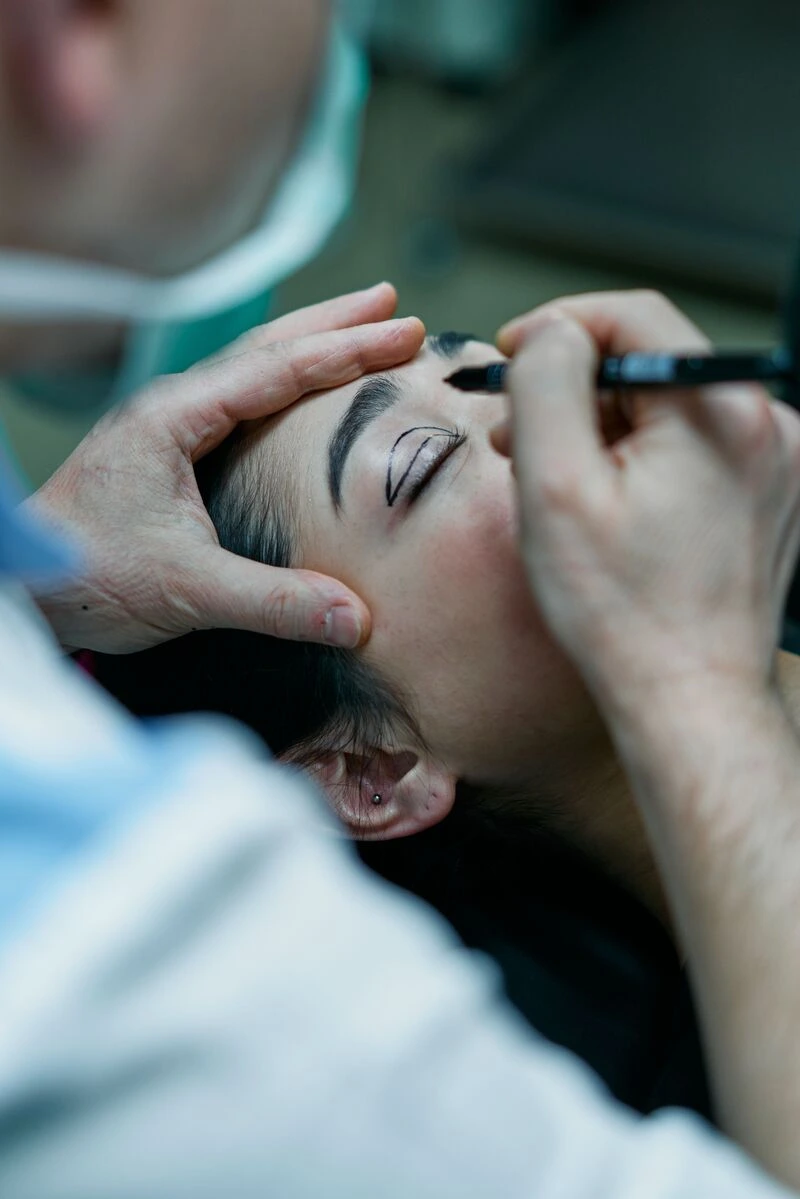
Pre-operative markings
The amount of skin and/or fat to be removed is precisely marked while the patient is sitting upright — gravity's effect on the tissues must be accounted for. Accurate marking is the foundation of a natural result.
Upper lid incision and tissue removal
For upper blepharoplasty: incision in the natural lid crease, precise excision of excess skin and any herniated fat. The orbicularis muscle is preserved or minimally resected to maintain natural lid function and expression.
Lower lid fat repositioning or removal
For lower blepharoplasty: fat is either removed or — in many cases — repositioned into the tear trough hollow for a smoother transition between lid and cheek. This repositioning technique avoids the hollowed-out look that can follow simple fat removal.
Canthopexy if indicated
If the lower lid is lax or shows ectropion tendency, a canthopexy (lateral canthal tightening) is performed to maintain proper lower lid position and prevent post-operative scleral show.
Meticulous skin closure
Fine sutures close the incisions. Upper lid scars fall into the natural crease and become invisible when the eye is open; transconjunctival lower lid incisions leave no external scar.
5. Who Is the Ideal Candidate?
Upper eyelid hooding
Excess skin folding over the upper lid margin — making the eyes appear smaller, heavier, and older than the patient's actual age.
Under-eye bags
Persistent puffiness under the eyes — regardless of sleep quality — due to herniated orbital fat. Often genetic and may appear in younger patients.
Tired / aged periorbital appearance
Looking tired, sad, or older than felt — caused by sagging upper lids, lower lid bags, or the combination of both.
Visual obstruction
In advanced upper eyelid ptosis or skin excess, peripheral vision may be impaired — a functional as well as aesthetic indication for surgery.
Good general health
No uncontrolled thyroid disease, dry eye syndrome, or other ocular conditions that could affect healing or surgical safety.
Realistic expectations
The goal is periorbital rejuvenation — restoring the eye's natural youthful appearance, not a fundamentally different eye shape.
6. Advantages of Blepharoplasty
Natural, non-operated look
When performed conservatively and with the correct technique, results are indistinguishable from simply being well-rested — not "done."
Invisible scars
Upper lid incisions sit in the natural crease and are invisible with the eye open. Transconjunctival lower lid approaches leave no external scar at all.
Long-lasting results
Upper blepharoplasty results typically last 7–10+ years. Lower blepharoplasty for fat bags — often indefinitely, as fat does not reform.
Short recovery
Most patients are presentable (with concealer) within 7–10 days. Among the shortest recovery periods of any facial surgery.
Functional benefit
Removing hooding from the upper lids can restore impaired peripheral vision and relieve the brow fatigue caused by chronically elevated brows trying to compensate.
Highly combinable
Can be combined with temporal lift, brow lift, mid facelift, or fat transfer in a single session for comprehensive periorbital and facial rejuvenation.
7. Recovery Timeline
Days 1–3
Swelling and bruising peak around the eyes. Cold compresses applied. Head kept elevated. Discomfort is typically mild and managed with simple oral medication.
Days 4–7
Bruising begins to yellow and fade visibly. Swelling reduces daily. Sutures are removed at day 5–7. Most patients can manage light indoor activities.
Week 2
Most patients are presentable with light concealer. International patients are typically cleared to fly home around day 10–12.
Weeks 3–4
Residual puffiness continues to settle. Full return to work and social activities for most patients.
Months 2–3
Final result is established. Incision lines fully matured and invisible in natural lid crease positions.
8. Combined with Facelift Surgery
When periorbital concerns accompany mid or lower face ageing, blepharoplasty can be performed in the same session as facelift surgery. According to Op. Dr. Necdet Urhan, this combined approach treats the face as a unified anatomical system — delivering a comprehensively refreshed result with a single anaesthetic and one recovery period.
Blepharoplasty Alone
When the primary concern is periorbital — eyelid hooding, under-eye bags, or a tired eye appearance — with no significant lower face laxity.
Facelift + Blepharoplasty
When both the eye area and lower face are ageing together — the most comprehensive rejuvenation in a single surgical session.
For full information on facelift surgery: Facelift Surgery Antalya →
9. Other Combination Procedures
Elevates the lateral brow, reducing the skin burden on the upper lid and enlarging the eye opening. + Brow Lift
Addresses descending brows across their full width — combined with blepharoplasty for comprehensive upper face rejuvenation. + Mid Facelift
Restores volume and lift to the cheek and mid face — smoothing the transition between the lower lid and cheek. + Facial Fat Transfer
Tear trough hollowing and periorbital volume loss restored with the patient's own fat tissue — no filler, permanent result.
10. Cost in Turkey — Why Antalya?
The cost of blepharoplasty varies depending on whether one or both eyelid pairs are treated and any combination procedures. In the USA, total costs typically range from $4,000–$12,000 USD. In Western Europe, the equivalent is €3,500–€10,000 EUR.
In Turkey — and specifically in Antalya — the same board-certified surgical expertise and accredited hospital infrastructure is available at significantly lower cost. A typical package includes:
Surgeon's fee
EBOPRAS-certified surgeon, chosen technique
Anaesthesia & theatre
Specialist anaesthetist, accredited hospital
Same-day discharge
Blepharoplasty is typically day-surgery — no overnight stay required
Post-operative follow-up
Suture removal, dressing checks, 10–12 day monitoring
Coordination service
English-speaking team, transfers, 24/7 contact
Fit-to-fly clearance
Final check-up and travel clearance 10–12 days post-surgery
For a personal quote: Pricing is prepared individually based on your eyelid anatomy and the procedures planned. Send photographs via WhatsApp or email to request a complimentary pre-assessment.
📞 +90 533 200 2664 |
✉️ info@drnecdeturhan.com |
💬 WhatsApp
11. Why Op. Dr. Necdet Urhan?
Op. Dr. Necdet Urhan is an EBOPRAS-certified Plastic and Aesthetic Surgery Specialist based in Antalya, Turkey. His practice is focused exclusively on facial aesthetics — eyelid surgery, temporal lift, and facelift surgery forming the core of his work. A significant proportion of his patients travel from the UK, Germany, and Scandinavia specifically for facial rejuvenation surgery in Antalya.
EBOPRAS Certified
European Board of Plastic, Reconstructive and Aesthetic Surgery — the highest board certification in European plastic surgery.
ISAPS Member
International Society of Aesthetic Plastic Surgery member.
Facial Aesthetics Only
Not a generalist clinic — a practice focused exclusively on the face.
Identity-Preserving Philosophy
Periorbital surgery done right should be invisible — not creating a different eye shape, but restoring the eye's own natural youthfulness.
12. Potential Risks
Potential risks of blepharoplasty include: swelling, bruising, temporary dry eye or tearing, asymmetry, scar maturation, infection, haematoma, lagophthalmos (incomplete eye closure), ectropion, and — rarely — the need for revision. Thorough pre-operative assessment — including evaluation of dry eye status and lower lid laxity — significantly reduces these risks. These are discussed in detail during the consultation.
13. Frequently Asked Questions
14. Appointment & Contact
Op. Dr. Necdet Urhan's clinic is located in Muratpaşa, Antalya — easily accessible from Antalya International Airport and the city centre. A fully English-speaking patient coordination team is available for pre-operative video consultations, hospital logistics, accommodation guidance, and post-operative support throughout the stay.
Contact Information
📞 +90 533 200 2664
✉️ info@drnecdeturhan.com
💬 Message on WhatsApp
📍 Yeşilbahçe Mh. Metin Kasapoğlu Cd. Gökhan İş Mrk. B Blok Kat:3 D:14, Muratpaşa / Antalya, Turkey
Related Pages
Medical Note: This page has been prepared by Op. Dr. Necdet Urhan's clinic for patient information purposes. Information available on the internet is not a substitute for a personal clinical examination; the surgical decision and technique selection must be determined by a physician assessment. Reviewed by Op. Dr. Necdet Urhan — Plastic and Aesthetic Surgery Specialist, EBOPRAS-certified, ISAPS Member, Antalya, Turkey.